AI Summary Liver fat quantification measures how much fat is in your liver without a biopsy. The CAP score, taken during a FibroScan, is quick and reports fat in dB/m. MRI-PDFF is an MRI scan and the most accurate noninvasive option. Doctors may suggest testing if you have risk factors or abnormal liver blood tests, or to track change over time. A biopsy may still be needed, and weight loss, diet, and exercise often reduce liver fat.

Source: www.liverdirectory.com

Liver Fat Quantification

Medically Reviewed.

Liver fat quantification means measuring how much fat is in the liver. A healthy liver holds a small amount of fat. Fat becomes a problem when it makes up more than 5% of the liver's weight, a condition called steatosis.

This page explains two tests in this group: the CAP score, which is measured during a FibroScan, and MRI-PDFF, an MRI scan that measures the liver's fat fraction. Neither test needs a biopsy.

Your care team chooses the test that fits your situation. CAP is quick and comes with a liver stiffness reading. MRI-PDFF is the most accurate noninvasive way to measure liver fat.

Below, you will find a side-by-side comparison, who may need each test, what to expect, how to read a CAP score, and answers to common questions.

AimyLiver Health AI Assistant
Ask about symptoms, tests, diet, or specialist care.
What does a FibroScan result mean?
I can explain the terms and help you prepare questions.
(opens in a new tab)

Ask Aimy

Turn confusion into a better next question.

Aimy answers from LiverDirectory’s reviewed health information — helping patients make sense of liver-health terms, prepare for specialist visits, and explore what to look up next.

By asking, you agree to the Terms & Conditions and Privacy Policy.

Liver fat measurement basics

What Is Liver Fat Quantification?

Steatosis is a buildup of fat in liver cells. When it is linked to weight, blood sugar, blood pressure, or cholesterol, doctors call it metabolic dysfunction-associated steatotic liver disease (MASLD). You may also see the older name, nonalcoholic fatty liver disease (NAFLD). Early on, it usually causes no symptoms and is often found during a routine checkup.

Liver fat quantification puts a number on the fat. That number helps your doctor see whether fat is present, how much there is, and whether it changes over time. It works best alongside liver function tests and your medical history.

The two tests on this page measure fat only. A FibroScan also reports liver stiffness in the same visit, but this page focuses on the fat reading.

Key Facts About Liver Fat Testing

  • 5%: Fat above 5% of the liver's weight counts as steatosis. A healthy liver holds a small amount of fat.
  • About 275 dB/m: A CAP value near this number is a suggested threshold to identify fatty liver (5% fat or more) in most situations.
  • MRI-PDFF: It is the most accurate noninvasive method to measure liver fat, with high agreement with biopsy results.
  • No biopsy needed: Both tests measure fat without a tissue sample. A biopsy is still the only way to tell MASLD from MASH.

Fatty liver test options

The Two Liver Fat Tests

Each test has its own page with more detail. Here is what sets them apart.

CAP Score (Controlled Attenuation Parameter)

CAP is measured with a FibroScan, a quick ultrasound-based test. A probe on your skin sends sound waves into the liver. Fat weakens, or attenuates, those waves. The more they weaken, the more fat the liver holds. The result is shown in decibels per meter (dB/m).

Measures:
Liver fat, in dB/m
Uses:
Painless sound waves
Time:
About 5 to 15 minutes

MRI-PDFF (Proton Density Fat Fraction)

MRI-PDFF uses an MRI scanner to measure the fraction of the liver made up of fat. It gives a precise, continuous number rather than a broad grade. It is the most accurate noninvasive method for measuring liver fat.

Measures:
Liver fat fraction
Uses:
Magnets and radio waves
Radiation:
None

Test comparison guide

CAP Score vs. MRI-PDFF

Both tests measure liver fat. They differ in how they work and how precise they are.

FeatureCAP score (FibroScan)MRI-PDFF
How it worksA probe on the skin sends painless sound waves into the liverAn MRI scanner uses magnets and radio waves
What you lie onAn exam table, on your back, with the right side of your abdomen exposedA table that slides into a tunnel-shaped scanner
What it reportsFat level in dB/m, plus a liver stiffness reading in the same testThe fat fraction of the liver, as a precise continuous number
AccuracyGood for grading fat; results can be affected by body weight (BMI), probe type, and liver stiffnessThe most accurate noninvasive method; closely matches biopsy findings
Best suited forQuick checks and follow-up in a clinicPrecise measurement, and tracking change during treatment
AvailabilityUsually done in a doctor's office or hospital clinicWhere MRI with this software is available

Your care team decides which test fits your situation, your health history, and what is available near you.

Reasons for testing

Who May Need a Liver Fat Test

A doctor may suggest one of these tests for several reasons.

You Have Risk Factors for Fatty Liver Disease

Obesity, diabetes, and high cholesterol are common risk factors. Fatty liver often causes no symptoms, so testing can find it early.

Your Liver Blood Tests Are Abnormal

Abnormal results do not say why the liver is affected. A fat measurement helps your doctor sort out the cause.

You Need to Be Monitored Over Time

Doctors repeat these tests to see whether liver fat changes after lifestyle changes or medical treatment.

Other Factors May Affect Your Liver

Long-term use of medicines that can affect the liver, or a history of heavy alcohol use, may lead your doctor to check for fat.

Being Tested Is Not a Diagnosis

A test order means your doctor wants more information. Abnormal results are a reason for follow-up, not proof of severe disease.

Preparing for your test

What Happens on Test Day

Both tests are painless and need no needles for the measurement itself. Here is how the day usually goes.

  • Before a CAP test: Fasting for at least two hours before a FibroScan is recommended, because food can affect the reading. Confirm the exact instructions with your clinic.
  • During a CAP test: You lie on your back with the right side of your abdomen exposed. The operator places a small probe on your skin over the liver. The test takes about 5 to 15 minutes.
  • Before an MRI-PDFF: Ask your care team how to prepare, including whether you need to fast.
  • During an MRI-PDFF: You lie on a table that slides into a tunnel-shaped scanner. You need to stay very still while images are taken. An MRI uses no radiation.
  • After either test: Your doctor reviews the results and explains the next step.

Ask your care team if you have questions before the day of your test. Instructions can differ between clinics.

CAP score ranges

How to Read a CAP Score

Values can vary slightly by machine and by patient.

Steatosis gradeCAP score (dB/m)What it suggests
NormalBelow 238Little or no fat
S1 (mild)238 to 259Mild fat buildup
S2 (moderate)260 to 290Moderate fat buildup
S3 (severe)Above 290Severe fat buildup

Reference ranges differ between sources. A cutoff near 275 dB/m is often used to identify fatty liver (5% fat or more) in most situations. Your doctor reads your number in context.

Support Your Diet Alongside Your Care

Amsety Bars were designed for people with liver conditions by liver health experts. They offer a convenient way to add energy and nutrients to a liver-friendly diet. Ask your provider what fits your needs.

Explore Liver Health Nutrition Bars
Amsety Bar in Dark Chocolate and Peanut Butter flavors

Interpreting your numbers

What Your Results Can Mean

MRI-PDFF Reports a Percentage

MRI-PDFF reports the fat fraction as a percentage of the liver. A higher percentage means more fat. Because the number is so precise, doctors can compare scans over time. In studies, a drop of 30% or more in liver fat has been seen with treatment, and doctors read this alongside blood tests and your overall health.

A Fat Measurement Is One Piece of the Picture

CAP can be affected by body weight, the type of probe, and liver stiffness. A high result does not tell your doctor why fat has built up, and a normal result does not rule out every liver problem. Depending on your results, your doctor may repeat the test, order blood work or more imaging, or suggest a biopsy.

Fat Often Improves With Lifestyle Changes

Fat in the liver often improves with weight loss, a balanced diet, and regular exercise. To learn about medical options, see the link below.

Find a liver specialist near you

Liver Health Coach
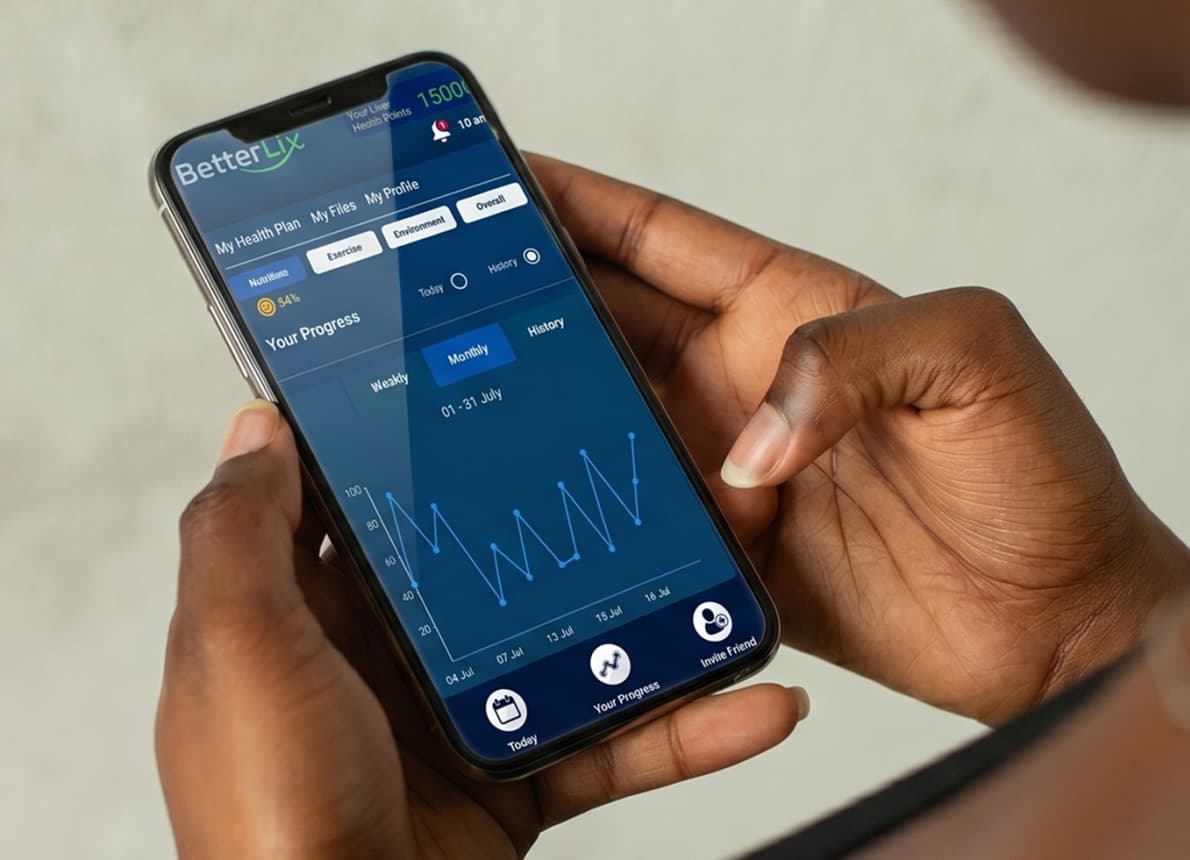
BetterLix app dashboard on a mobile phone

Liver health support

Support Your Liver Health Journey with BetterLix

BetterLix is a digital liver health support app designed to help you understand liver conditions, track symptoms, and build healthier daily habits. It provides simple, personalized guidance to help you stay informed about your liver health and monitor progress over time.

  • Liver symptom tracking and monitoring
  • Daily liver health habit guidance
  • Educational insights about liver conditions
  • Progress tracking for liver wellness

Common Questions

Answers to Common Liver Fat Quantification Questions

Can Liver Fat Be Measured Without a Biopsy?

Yes. A FibroScan with CAP and an MRI-PDFF both measure liver fat without a tissue sample. CAP uses painless sound waves. MRI-PDFF uses an MRI scanner. Each test gives a number that shows how much fat the liver holds. A biopsy is still the only way to tell MASLD from MASH. Your doctor may suggest one if your fat measurement, blood tests, and imaging leave questions.

What Is a CAP Score?

A CAP score is a number that shows how much fat is in your liver. It comes from a FibroScan. During the test, fat in the liver weakens the sound waves from the probe. The more the waves weaken, the higher the score. The result is shown in decibels per meter (dB/m). A common reference puts a normal result below 238 dB/m. Scores of 238 to 259 suggest mild fat buildup, 260 to 290 moderate, and above 290 severe. Ranges differ slightly between machines, and a cutoff near 275 dB/m is often used to identify fatty liver. Your doctor reads your number in context.

Is MRI-PDFF Better Than a CAP Score?

MRI-PDFF is more accurate. It is the most accurate noninvasive method for measuring liver fat, and it closely matches biopsy findings. It gives a precise, continuous number, so doctors can use it to track change over time, including during treatment. CAP is still useful. It is faster, it is done in a clinic, and it comes with a liver stiffness reading. Body weight (BMI), the type of probe, and liver stiffness can affect a CAP result. Your doctor picks the test based on your situation and what is available near you.

Do These Tests Hurt or Use Radiation?

No. Both tests are painless, and neither uses radiation. For CAP, you lie on your back with the right side of your abdomen exposed. The operator rests a small probe on your skin over the liver. The test takes about 5 to 15 minutes. For MRI-PDFF, you lie on a table that slides into a tunnel-shaped scanner. You need to stay very still while images are taken. Ask your care team how to prepare, including whether you need to fast.

Does a High CAP Score Mean I Have Serious Liver Disease?

Not always. A high score means fat is present, but it does not show severe disease by itself. It also does not say why the fat has built up. Your doctor looks at your score with your blood tests, your medical history, and sometimes a liver stiffness reading, which measures scarring. Depending on the results, your doctor may repeat the test or order blood work, more imaging, or a biopsy. An abnormal result is a reason for follow-up, not proof of serious disease.

Medical disclaimer: LiverDirectory provides educational information and a directory of providers. It does not provide medical advice, diagnosis, or treatment. Always consult a licensed physician regarding any medical condition.