
FibroScan (Transient Elastography)
FibroScan is the best-known elastography test. A probe placed over the liver measures stiffness. It also estimates liver fat with a CAP score. The scan takes about 5 to 10 minutes.
AI Summary Liver elastography is a painless scan that estimates scarring (fibrosis) by measuring liver stiffness in kilopascals. Tests include FibroScan, Velacur, and shear wave elastography. Doctors order them to look for scarring early, monitor known liver conditions, and sometimes avoid a biopsy. Results depend on device, quality checks, body size, and recent food. A high number calls for follow-up, not a diagnosis, so your care team reads it with your other results.
Source: www.liverdirectory.com
Medically Reviewed.
Elastography is a group of painless tests that estimate how stiff the liver is. Stiffness matters because scar tissue, called fibrosis, makes the liver firmer.
This page covers ultrasound-based tests such as FibroScan, Velacur, and shear wave elastography. It explains how they work, when doctors order them, and what the results can mean.
These tests can often help your care team check for fibrosis without a liver biopsy. They do not name the cause of liver disease, so doctors read them alongside your blood tests, imaging, and health history.
Use the links on this page to read about each test. Your care team chooses the test that fits your situation.

 Liver Health AI Assistant

Ask Aimy
Aimy answers from LiverDirectory’s reviewed health information — helping patients make sense of liver-health terms, prepare for specialist visits, and explore what to look up next.
Liver stiffness basics
Liver fibrosis is scarring that builds up when the liver stays injured or inflamed for a long time. Common causes include viral hepatitis, alcohol-related liver disease, and fatty liver disease (also called MASLD or NAFLD).
Elastography measures how stiff liver tissue is. Most ultrasound-based tests send a gentle vibration, called a shear wave, through the liver and time how fast it travels. The wave moves faster through stiffer tissue, and stiffer tissue usually means more scarring. The result is called liver stiffness and is reported in kilopascals (kPa).
Doctors use three main imaging methods to assess fibrosis: transient elastography, shear wave elastography, and MR elastography. They use them to estimate how much scarring is present and to track it over time.
Elastography does not diagnose a specific disease. It shows how much scarring may be present so your care team can decide what to do next.
Types of tests
Each test has its own page with more detail. Here is what sets them apart.
FibroScan is the best-known elastography test. A probe placed over the liver measures stiffness. It also estimates liver fat with a CAP score. The scan takes about 5 to 10 minutes.
Velacur uses ultrasound-based shear waves, an external vibration source, and a scanning probe to measure liver stiffness and liver fat. It adds detailed imaging and automated quality checks, which aim to make results less dependent on the operator.
SWE measures liver stiffness using shear waves. It comes in two forms: point-SWE and 2D-SWE.
ARFI elastography is part of this group of stiffness tests. Its page explains how it works and how it compares with the others.
2D-SWE is one of the shear wave methods used to assess liver fibrosis. Its page covers what sets it apart.
Compared side by side
Doctors choose among these tests based on what is available and what your situation needs.
| Test | How it works | What it reports | Good to know |
|---|---|---|---|
| FibroScan (transient elastography) | A probe on the skin sends a gentle vibration into the liver and times the wave. | Liver stiffness (kPa) and liver fat (CAP score, dB/m) | Takes about 5 to 10 minutes. An XL probe can reduce failed readings in people with obesity. |
| Velacur | Ultrasound shear waves with an external vibration source and a scanning probe. | Liver stiffness (kPa) and liver fat (dB/m) | Adds detailed imaging and automated quality checks. |
| Shear wave elastography (SWE) | Measures stiffness during an ultrasound exam. Comes in point-SWE and 2D-SWE forms. | Liver stiffness (kPa) | Ranks with transient elastography and MRE as a main imaging method for fibrosis. |
| MR elastography (MRE) | Adds vibrations to an MRI scan to map stiffness across the liver. | A picture of stiffness across the whole liver | Uses magnets and radio waves, not radiation. Its kPa cutoffs are lower than ultrasound-based tests. |
MR elastography is covered under Cross-Sectional Imaging. It is shown here for comparison.
When it's recommended
Your doctor may suggest one of these tests at several points in your care.
Abnormal liver blood tests, metabolic risk factors such as obesity, diabetes, or high cholesterol, long-term use of medicines that can affect the liver, or a history of heavy alcohol use can all lead a doctor to check for fibrosis.
Doctors use elastography to follow people with hepatitis B, hepatitis C, fatty liver disease, or alcohol-related liver disease. Repeat scans show whether stiffness is holding steady or changing.
In people with inactive hepatitis B and normal ALT, transient elastography is preferred over biopsy to rule out severe fibrosis and cirrhosis. Finding cirrhosis matters because it guides checks for complications such as portal hypertension and liver cancer.
Imaging after a blood-based score, such as FIB-4, can raise diagnostic confidence and may reduce unnecessary biopsies.
What to expect
Ultrasound-based elastography is painless and usually done in a clinic or hospital.
Ask your care team whether you need to fast before the scan. Recent food intake can raise stiffness readings.
Understanding results
Fibrosis is often grouped into stages from F0 to F4. Higher stiffness usually points to a higher stage.
A high result is a reason for follow-up, not a diagnosis. Your doctor may repeat the test or order blood work, other imaging, or a biopsy.
Cutoffs vary by device, cause of liver disease, and patient factors. Your result page or doctor may use different numbers. Always read your own report with your care team.
Amsety Bars were designed for people with liver conditions by liver health experts. They offer a convenient way to add energy and nutrients to a liver-friendly diet. Ask your provider what fits your needs.
Explore Liver Health Nutrition Bars
Result accuracy factors
Elastography is useful, but no single number tells the whole story.
A valid transient elastography session needs at least 10 valid readings, a success rate above 60%, and an IQR below 30% of the median stiffness. An IQR is a quality check that shows how much the readings vary. Results that miss these marks may need a repeat scan.
Several conditions can push stiffness readings higher than the true level of scarring. These include active ALT flares, blocked bile flow outside the liver, congestive heart failure, recent food intake, and heavy alcohol use.
Unreliable results can reach up to 20% in some studies, mostly in people with a high BMI or thick tissue over the chest wall. A larger XL probe was developed to reduce failed readings in people with obesity.
Transient elastography finds cirrhosis (F4) more reliably than earlier advanced fibrosis (F3). Doctors may combine it with a blood score or another test to settle unclear results.
 Liver Health Coach
Liver health support
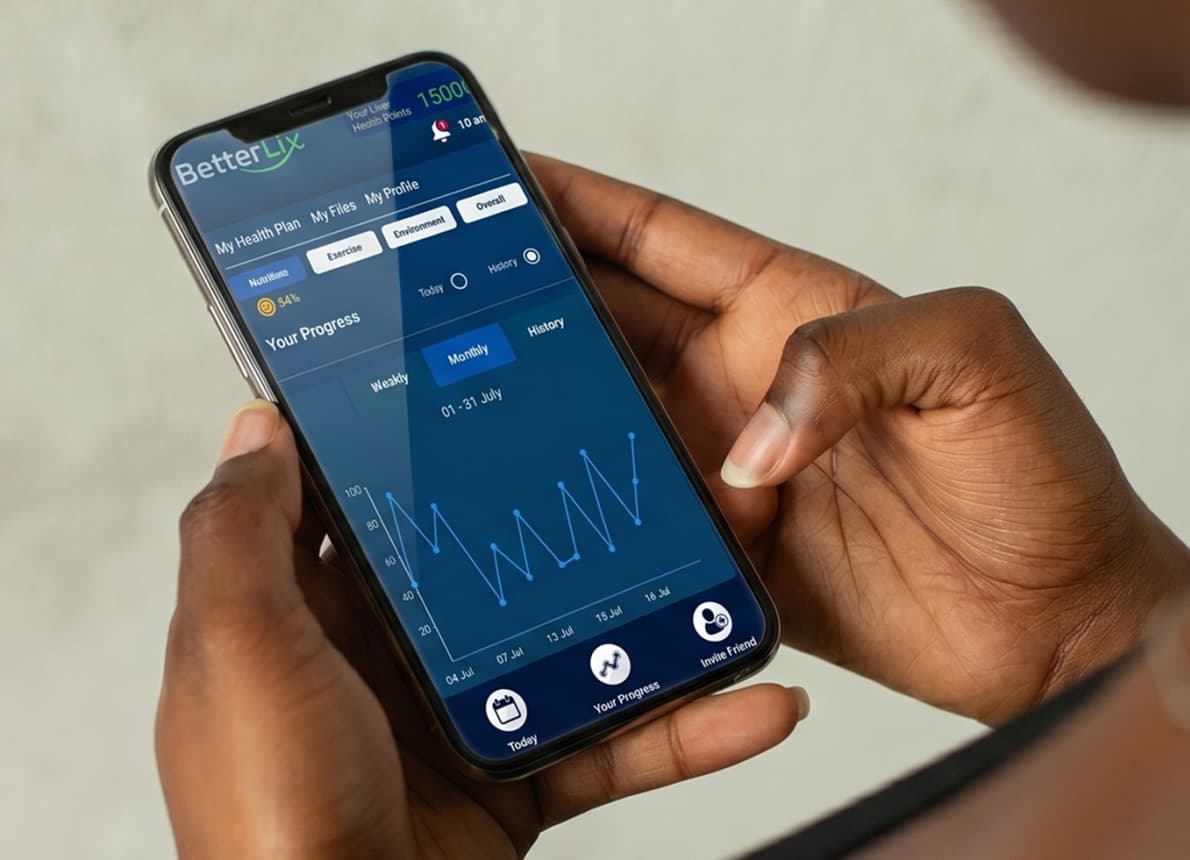
BetterLix is a digital liver health support app designed to help you understand liver conditions, track symptoms, and build healthier daily habits. It provides simple, personalized guidance to help you stay informed about your liver health and monitor progress over time.
Common questions
No. Ultrasound-based elastography is painless and non-invasive. You lie on your back with the right side of your abdomen exposed, and a probe rests on the skin over your liver. The device sends gentle vibrations into the liver and measures how fast they travel.
About 5 to 10 minutes for FibroScan and Velacur. Your appointment may run longer with check-in and setup. The device takes several readings during the scan. If the readings miss quality checks, you may need a repeat scan. Your doctor then reviews the numbers with your blood tests, imaging, and health history.
Sometimes. Noninvasive tests are safer and easier to repeat than biopsy, and transient elastography is preferred over biopsy for ruling out severe fibrosis in some people with hepatitis B. If results are unclear or your doctor needs a tissue answer, a biopsy may still be advised. A liver biopsy remains the most precise way to stage fibrosis.
No. A high stiffness value is a reason for follow-up, not a diagnosis. Values of 15 kPa or higher suggest cirrhosis with high specificity, but cutoffs vary by device and cause of liver disease. Other conditions can also raise readings, such as active ALT flares, congestive heart failure, recent food intake, and heavy alcohol use. Your doctor reads the number with your other results and may repeat the test or order blood work, other imaging, or a biopsy.
Possibly. Recent food intake can raise stiffness readings, so a reading may look higher than the true level of scarring. Follow the instructions your clinic gives you about eating before the scan. If you did not get instructions, ask your care team before the day of your test.
Medical disclaimer: LiverDirectory provides educational information and a directory of providers. It does not provide medical advice, diagnosis, or treatment. Always consult a licensed physician regarding any medical condition.

