
MELD Score
The Model for End-Stage Liver Disease (MELD) estimates short-term risk in advanced liver disease. It uses three blood results: bilirubin, creatinine, and INR. Transplant teams use it to help rank urgency.
AI Summary Liver severity and cirrhosis scores turn test results into a number or class that helps doctors judge how advanced liver disease is. MELD and MELD-Na use bilirubin, creatinine, and INR, with sodium added in MELD-Na, while Child-Pugh sorts cirrhosis into class A, B, or C. Higher MELD scores mean higher short-term risk. Teams use scores for transplant priority, surgery planning, and liver cancer surveillance. A score is a snapshot, not a verdict.
Source: www.liverdirectory.com
Medically Reviewed.
Liver severity scores turn test results into a number or a class. Doctors use them for people with advanced liver disease, especially cirrhosis, which is permanent scarring of the liver. The best-known scores are MELD, MELD-Na, and Child-Pugh.
This page introduces the group and points you to a detailed guide on each score.
Below, you will find key facts, a side-by-side comparison, what MELD ranges mean, how doctors use the scores, and answers to common questions.

 Liver Health AI Assistant

Ask Aimy
Aimy answers from LiverDirectory’s reviewed health information — helping patients make sense of liver-health terms, prepare for specialist visits, and explore what to look up next.
Liver Disease Severity Basics
A liver severity score combines lab results into one number or class. It gives your care team a steady, repeatable way to judge how well your liver is working and how likely complications are in the near term. These scores matter most in cirrhosis, the permanent scarring that slowly replaces healthy liver cells. Doctors describe two broad stages.
Cirrhosis Scoring Systems
Each score answers a slightly different question. Open a guide for details.
The Model for End-Stage Liver Disease (MELD) estimates short-term risk in advanced liver disease. It uses three blood results: bilirubin, creatinine, and INR. Transplant teams use it to help rank urgency.
MELD-Na adds sodium to the MELD formula. Low sodium can signal more severe liver disease than the original MELD alone shows.
The Child-Pugh system, also called Child-Turcotte-Pugh (CTP), sorts cirrhosis into class A, B, or C. Doctors use the class to estimate surgical risk and to decide who needs liver cancer surveillance.
Side-by-Side Score Comparison
The scores overlap, but each has a main job.
| Score | What it gives you | Main uses | Good to know |
|---|---|---|---|
| MELD | A number built from bilirubin, creatinine, and INR | Transplant priority, medical management, short-term risk | Needs no procedure. Some conditions, such as certain liver tumors, are not captured by the formula. |
| MELD-Na | A MELD number that also uses sodium | Same uses as MELD, with sodium added | MELD 3.0 goes further by adding female sex and albumin. |
| Child-Pugh (CTP) | A class: A, B, or C | Surgical risk and liver cancer surveillance decisions | Gives broader groups than MELD. MELD gives more detailed risk estimates. |
MELD Score Interpretation
Higher scores mean higher short-term risk. These figures are group estimates, not predictions for one person.
| MELD score | Risk level | What it may mean | 90-day risk of death |
|---|---|---|---|
| 6–9 | Low | Liver function is relatively preserved | 1.9% |
| 10–19 | Moderate | Some liver dysfunction; closer monitoring may be needed | 6% |
| 20–29 | High | Significant dysfunction; urgent transplant evaluation may be needed | 19.6% |
| 30–39 | Very high | Severe liver disease; likely candidate for urgent transplant | 52.6% |
| 40 and above | Critical | Extremely high risk without immediate intervention | 71.3% |
Your score is only one factor: blood type and donor availability also affect transplant timing.
Scores in Clinical Care
Your care team may use these scores in several ways.
Transplant teams order blood tests to calculate your MELD score. It is the key number that ranks urgency, and you are not listed until it is high enough. Blood type and donor availability also affect timing.
Some conditions carry more urgency than the formula shows. Examples include hepatopulmonary syndrome, portopulmonary hypertension, and liver cancer. In these cases, patients may receive extra exception points.
Both the Child-Pugh class and the MELD score help doctors estimate risk before surgery in people with cirrhosis. Thirty-day risk rises about 1% per MELD point up to about 22, then about 2% per point.
Liver cancer surveillance is recommended for people with Child-Pugh A or B cirrhosis, and for Child-Pugh C patients who are transplant candidates. See [liver cancer surveillance and tumor testing](/liver-tests/liver-cancer-surveillance-tumor-testing).
Scores are recalculated as labs change. A rising number can prompt a closer look at your plan. Related tests, such as [HVPG](/liver-tests/invasive-testing/portal-pressure-assessment/hvpg) for portal pressure, add detail that a score cannot.
Amsety Bars were designed for people with liver conditions by liver health experts. They offer a convenient way to add energy and nutrients to a liver-friendly diet. Ask your provider what fits your needs.
Explore Liver Health Nutrition Bars
Doctor Visit Checklist
Clear information helps your team calculate scores that reflect your health.
If you have symptoms such as yellow skin or eyes, swelling in the belly, or vomiting blood, speak with your doctor as soon as possible.
Download Free Liver Test Patient Guide Liver Health Coach
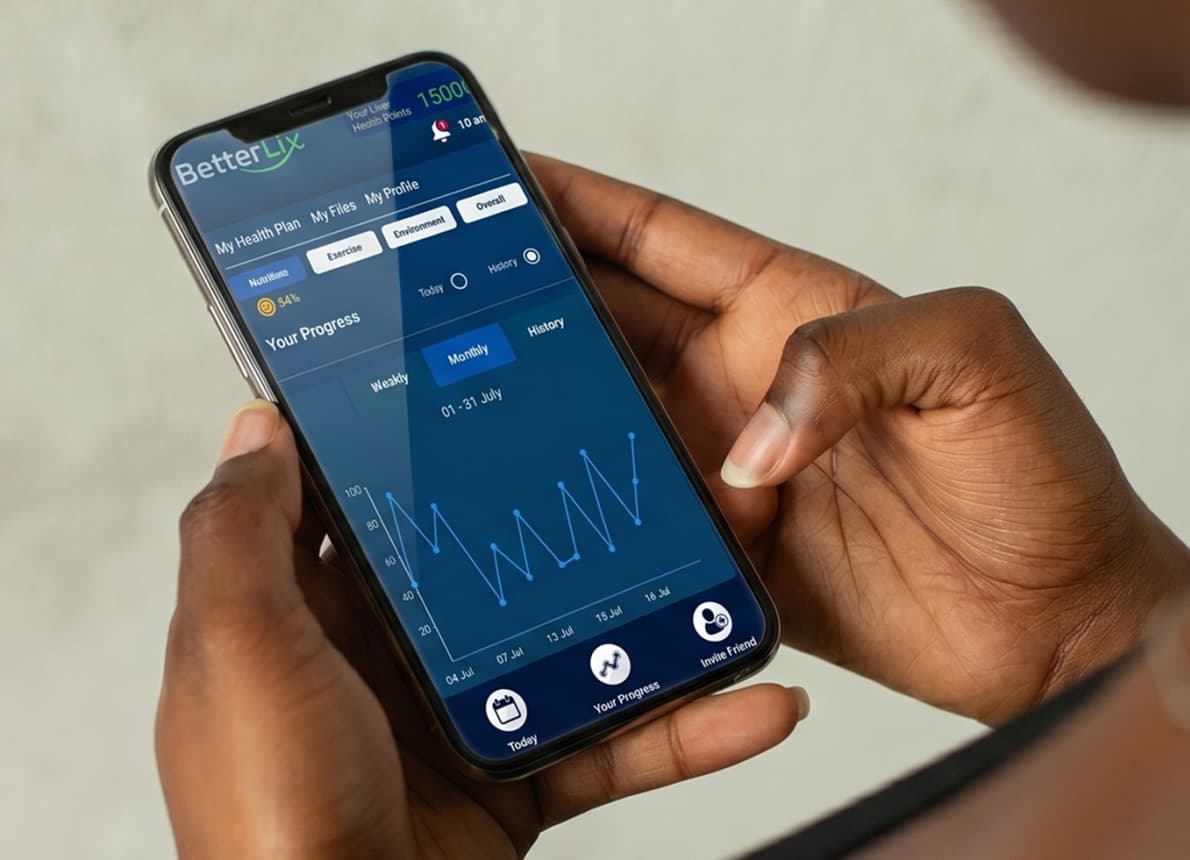
Liver health support
BetterLix is a digital liver health support app designed to help you understand liver conditions, track symptoms, and build healthier daily habits. It provides simple, personalized guidance to help you stay informed about your liver health and monitor progress over time.
Common Question
MELD-Na adds a sodium blood level to the MELD formula. MELD uses three blood results: bilirubin, which shows how well the liver clears bile; creatinine, which reflects kidney function; and INR, which measures blood clotting. Low sodium can signal more severe liver disease, so MELD-Na can capture risk that MELD alone may miss. Both scores come from blood tests, with no procedure. A newer version, MELD 3.0, also adds female sex and albumin. See the [MELD-Na guide](/liver-tests/medical-scores/liver-severity-cirrhosis-scores/meld-na) for details.
Not always. A MELD score of 20 to 29 is considered high risk and may lead to an urgent transplant evaluation. A score of 30 to 39 is very high risk, and you may be a candidate for urgent transplant. Even so, your score is only one factor. Your blood type and the number of donors available in your region also affect how long you may wait. Some conditions also earn extra exception points. Your transplant team can explain how your score fits your own plan.
Your score changes because it is calculated from your lab results, and those results can shift. For people on the transplant list, fresh labs arrive each week, and the number may inch up or down. Treat one score as a snapshot, not a verdict. A dip or a rise is a good reason to check in with your team about your health plan. If you receive exception points, those are reviewed every few months, so ask your coordinator when the next review is.
Yes. Child-Pugh sorts cirrhosis into class A, B, or C. Doctors use the class to decide who needs liver cancer surveillance: people with class A or B, and class C patients who are transplant candidates. Surgeons also use it, along with MELD, to estimate risk before surgery. Child-Pugh gives broader groups than MELD, while MELD gives more detailed risk estimates. For this reason, doctors often look at both.
Scores help show how far cirrhosis has progressed. Cirrhosis is permanent scarring of the liver. In compensated cirrhosis, there are no overt complications yet. In decompensated cirrhosis, complications such as ascites, variceal bleeding, hepatic encephalopathy, or jaundice have appeared. Higher scores generally point to more advanced disease. A score does not replace your doctor's judgment, so ask your team what your score means for you.
Medical disclaimer: LiverDirectory provides educational information and a directory of providers. It does not provide medical advice, diagnosis, or treatment. Always consult a licensed physician regarding any medical condition.

